Workshop
The Global Bible exhibition was launched following an international workshop at the University of Münster on 10 October 2025.

The workshop included three panels, beinning with a series of presentations by representatives from international Bible societies active in the three case study regions of the Global Bible project. Dr Kennedy Kwame Owiredu of the Ghana Bible Society discussed the current work of the society in multiple media and the many languages of Ghana. These include recent work to make video recordngs of Bible translation in Ghanaian sign language. This is particularly important becuase of the low literacy rates among deaf Ghanaians. This was followed by an account by Friedrich Tometten, Bible consultant for the Indonesian Bible Society, of his fieldwork translating into Yali (Yaly, Jalè, Jaly) a Papuan language of Indonesian New Guinea. Tometten argued that language was a powerful instrument for identity in the face of intense colonial pressure, in this case Indonesian. He illustrated the complex layers of meaning possible in Yali and the unique world view it was able to represent. This session was followed by a presentation by Leeza Awajobi including a video of her poetic response to missionary Christianity and the loss of her mother tongue. After lunch, there were three presentations, by Floris Solleveld on Bible societies and comparative linguistics, by Hilary Carey on the Bible in the Arctic, and Marha Fredericks on translating the Bible on the Gold Coast and the politics of using ajami (Arabic) script to print Christian scripture. In the final session, Dr Christian Hermann provided an overview of the recent exhibition at the State Library of Württemberg (Württembergische Landesbibliothek or WLB), which currently has one of the world’s largest Bible collections and has recently held an exhibition on the colonial impact and reception of the Bible. The lead researcher for the exhibition, Michael Wandusim, provided an overview of the methodology and rationale behind the choice of exhibits for inclusion in the exhbition, noting that the intention was to illuminate the lengthy process involved in a Bible translation as well as the particular role of mother tongue and Indigenous co-translators in the process.
Exhibition
The workshop was followed by a reception and talk to launch the exhibition and the newly published catalogue, displayed in the image below. The launch was well attended by people of all ages who relished the opportunity to examine exhibits from across the world, and close to home, in the highly curated and professional context provided by the Bible museum.
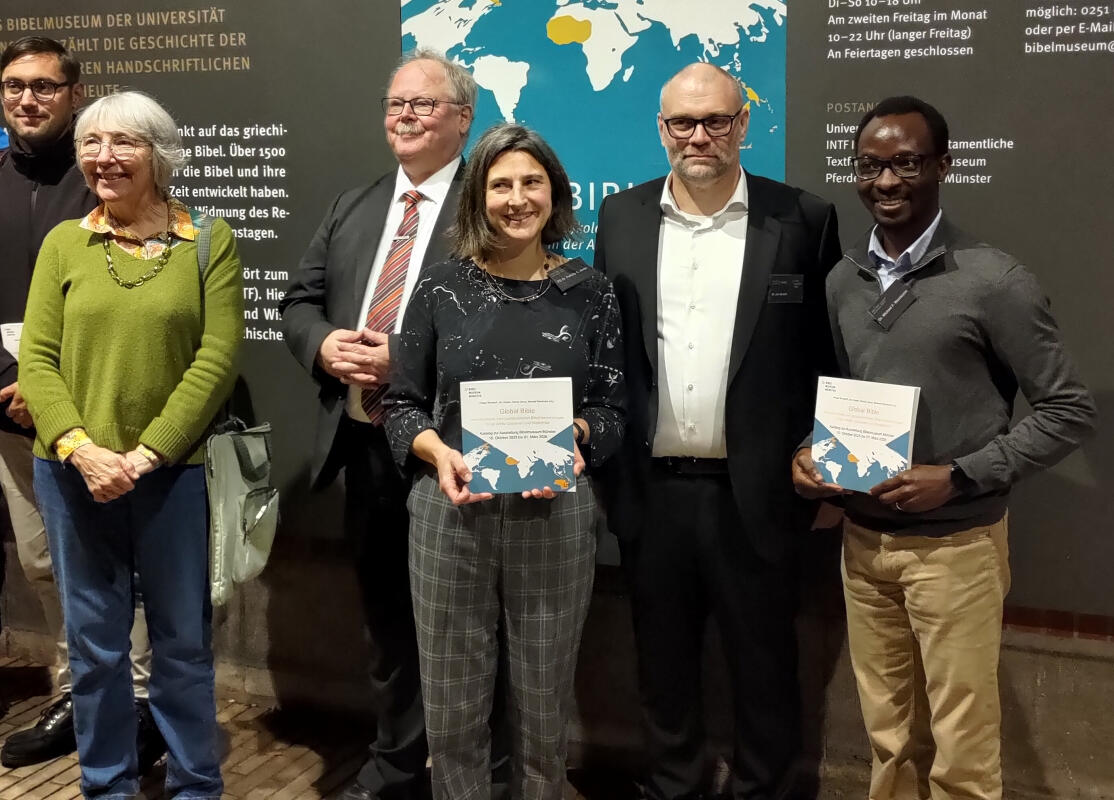
The Global Bible exhibition runs until 1 March 2026, with a public guided tour taking place every Sunday at 3 p.m. The exhibition is the culmination of three years of research and collaboration with researchers, Bible societies, artists and museum professionals looking at the colonial and post-colonial legacies of Bible translation.
In his presentation to the opening session, Prof. Holger Strutwolf (Direktor Bibelmuseum) described the origins of Bible translation and the complex histories of landmark works, such as Erasmus’s Greek New Testament (1516), generally referred to as the first published edition in the original Greek language.
Felicity Jensz introduced the first of the three case study regions of the Global Bible project, namely that for the Arctic. In this section, ethnographic artefacts sourced from the Moravian archives have been placed together with the first translations into Greenlandic (Kalaallisut) which were originally completed under royal patronage in the 18th century.
Michael Wandusim then discussed the exhibits relating to Ghana in West Africa, noting that Bibles were only the last stage of a complex translation process, that also involved the creation of word lists, orthography, grammars, and translations of short sentences, passages and scripture books, before culiminating – if ever – in a complete translation of all books of the Bible.
The third case study region is that of Oceania and Australia, vast regions in which there were multiple incursions by different imperial and Christian missionary agencies. This is reflected in the complex transmission history of Bibles in this region. One telling example, is the Tahitian Bible of Pomare II (1774-1821), completed after his strategic alliance with the London Missionary Society. Pomare leading not just to translation of the Bible, but also a new lawcode.

Reflections on the colonial reception of Bible translations was led by spoken word artist, Leeza Awojobi, whose poem was one of two commissioned art works produced as part of the project. Three drawings by New Guinea artist Alfred Manfred Wkeng Aseng narrated the missionary journey of his brother, who donated land to the Anglican mission to come to the village and set up a church and school. Floris Solleveld explained the process which led Aseng to contribute to the project and the need for Indigenous perspectives on the colonial process.
Finally, there was a presentation of works which have been used to develop the digital map of Bible translations, including the Book of a Thousand Tongues, originally published by the American Bible Society in 1939, and re-issued with a marked turn to empower mother tongue translators under the editorship of Eugene Nida for the United Bible Society in 1972. This has formed by the basis for the Global Bible Project (GloBil) dataset, an accessible dataset available in multiple formats with a range of queries now available through FactGrid.
Catalogue
The Global Bible exhibition is accompanied by a comprehensive catalogue of over 100 exhibits and thematic essays. This is published by LIT Verlag and edited by Holger Strutwolf, Jan Graefe, Felicity Jensz and Michael Wandusim: Global Bible – Legacies of (post)colonial Bible translations in the Arctic, Oceania, and West Africa. Catalogue for the exhibition at the Bibelmuseum Münster from 10 October 2025 to 1 March 2026. Copies may be obtained from the publisher.


