Global Bible Exhibition and Workshop, Münster.

Workshop

The Global Bible exhibition was launched following an international workshop at the University of Münster on 10 October 2025.

Left to right: Michael Wandusim, Felicity Jensz, Ben Weber, Christian Herrmann, Hilary Carey, Holger Strutwolf, Martha Frederiks, Floris Solleveld, Kennedy Kwame Owiredu, Friedrich Tometten.

The workshop included three panels, beinning with a series of presentations by representatives from international Bible societies active in the three case study regions of the Global Bible project. Dr Kennedy Kwame Owiredu of the Ghana Bible Society discussed the current work of the society in multiple media and the many languages of Ghana. These include recent work to make video recordngs of Bible translation in Ghanaian sign language. This is particularly important becuase of the low literacy rates among deaf Ghanaians. This was followed by an account by Friedrich Tometten, Bible consultant for the Indonesian Bible Society, of his fieldwork translating into Yali (Yaly, Jalè, Jaly) a Papuan language of Indonesian New Guinea. Tometten argued that language was a powerful instrument for identity in the face of intense colonial pressure, in this case Indonesian. He illustrated the complex layers of meaning possible in Yali and the unique world view it was able to represent.  This session was followed by a presentation by Leeza Awajobi including a video of her poetic response to missionary Christianity and the loss of her mother tongue. After lunch, there were three presentations, by Floris Solleveld on Bible societies and comparative linguistics, by Hilary Carey on the Bible in the Arctic, and Marha Fredericks on translating the Bible on the Gold Coast and the politics of using ajami (Arabic) script to print Christian scripture. In the final session, Dr Christian Hermann provided an overview of the recent exhibition at the State Library of Württemberg (Württembergische Landesbibliothek or WLB), which currently has one of the world’s largest Bible collections and has recently held an exhibition on the colonial impact and reception of the Bible. The lead researcher for the exhibition, Michael Wandusim, provided an overview of the methodology and rationale behind the choice of exhibits for inclusion in the exhbition, noting that the intention was to illuminate the lengthy process involved in a Bible translation as well as the particular role of mother tongue and Indigenous co-translators in the process.

Exhibition

The workshop was followed by a reception and talk to launch the exhibition and the newly published catalogue, displayed in the image below. The launch was well attended by people of all ages who relished the opportunity to examine exhibits from across the world, and close to home, in the highly curated and professional context provided by the Bible museum.
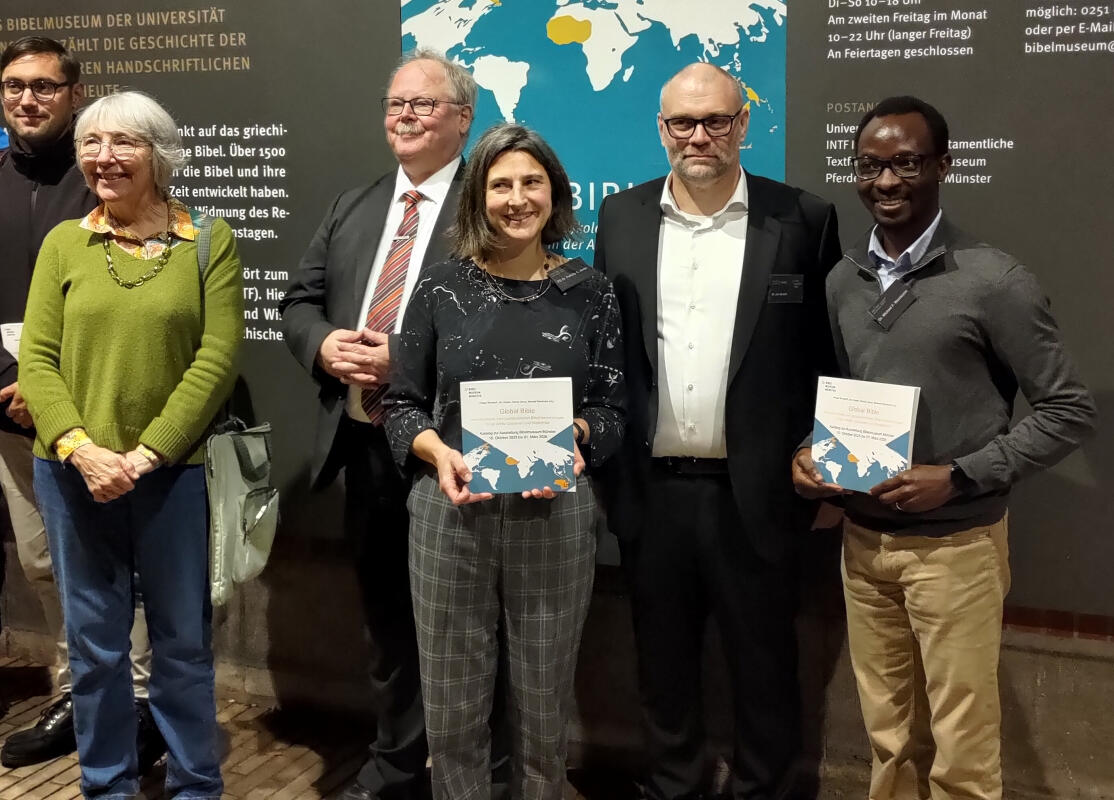
Prof. Hilary Carey (Bristol), Prof. Holger Strutwolf (Director of the Bible Museum), Dr. Felicity Jensz (GloBil), Dr. Jan Graefe (Curator of the Bible Museum) and Dr. Michael Wandusim (GloBil), from left to right

The Global Bible exhibition runs until 1 March 2026, with a public guided tour taking place every Sunday at 3 p.m. The exhibition is the culmination of three years of research and collaboration with researchers, Bible societies, artists and museum professionals looking at the colonial and post-colonial legacies of Bible translation.

In his presentation to the opening session,  Prof. Holger Strutwolf (Direktor Bibelmuseum) described the origins of Bible translation and the complex histories of landmark works, such as Erasmus’s Greek New Testament (1516), generally referred to as the first published edition in the original Greek language.

Felicity Jensz introduced the first of the three case study regions of the Global Bible project, namely that for the Arctic. In this section, ethnographic artefacts sourced from the Moravian archives have been placed together with the first translations into Greenlandic (Kalaallisut) which were originally completed under royal patronage in the 18th century.

Michael Wandusim then discussed the exhibits relating to Ghana in West Africa, noting that Bibles were only the last stage of a complex translation process, that also involved the creation of word lists, orthography, grammars, and translations of short sentences, passages and scripture books, before culiminating – if ever – in a complete translation of all books of the Bible.

The third case study region is that of Oceania and Australia, vast regions in which there were multiple incursions by different imperial and Christian missionary agencies. This is reflected in the complex transmission history of Bibles in this region. One telling example, is the Tahitian Bible of Pomare II (1774-1821), completed after his strategic alliance with the London Missionary Society. Pomare leading not just to translation of the Bible, but also a new lawcode.

Leeza Awojobi
Poet and storyteller, Leeza Awojobi.

Reflections on the colonial reception of Bible translations was led by spoken word artist, Leeza Awojobi, whose poem was one of two commissioned art works produced as part of the project. Three drawings by New Guinea artist Alfred Manfred Wkeng Aseng narrated the missionary journey of his brother, who donated land to the Anglican mission to come to the village and set up a church and school. Floris Solleveld explained the process which led Aseng to contribute to the project and the need for Indigenous perspectives on the colonial process.

Finally, there was a presentation of works which have been used to develop the digital map of Bible translations, including the Book of a Thousand Tongues, originally published by the American  Bible Society in 1939, and re-issued with a marked turn to empower mother tongue translators under the editorship of Eugene Nida for the United Bible Society in 1972. This has formed by the basis for the Global Bible Project (GloBil) dataset, an accessible dataset available in multiple formats with a range of queries now available through FactGrid. 

Catalogue

The Global Bible exhibition is accompanied by a comprehensive catalogue of over 100 exhibits and thematic essays. This is published by LIT Verlag and edited by Holger Strutwolf, Jan Graefe, Felicity Jensz and Michael Wandusim: Global Bible – Legacies of (post)colonial Bible translations in the Arctic, Oceania, and West Africa. Catalogue for the exhibition at the Bibelmuseum Münster from 10 October 2025 to 1 March 2026. Copies may be obtained from the publisher.

Translating Colonialism conference

Translating colonialism conference

Last week, international delegates from around the world met for the Translating Colonialism conference at Westminster College, University of Cambridge.

The conference was the major event for the second year of the Global Bible project, and has been over a year in the planning and thinking.

Congratulations and thank you to everyone who joined us for this event!

Translating colonialism conference
Delegates to the Translating Colonialism Conference, Westminster College Cambridge, 7-8 November 2024.

Papers were organised into panels which corresponded roughly to geographical and chronological themes, though the range and diversity of topics and approaches was a key feature of the conference.

The conference began with a short presentation by the Global Bible team, both the Münster strand led by Felicity Jensz and Michael Wandusim (who was unfortunately not able to attend) and the Bristol strand, with Hilary Carey, Floris Solleveld, and Mei Mei Cheung. This outlined the origins of the project and its focus on three case study regions in colonial West Africa, Oceania, and the Arctic, but with the conference extending that to include participants presenting on bible translation in China, Russia, India and across a wider time frame, from the early Christian era to the modern day.

For the first panel, Daniel Jeyaraj (Liverpool Hope) and Hepzibah Israel (Edinburgh) took us to Tamil Nadu. Jeyaraj discussed the Danish Lutheran missionaries who undertook the first translations into Tamil in the Danish colony of Tranquebar. Israel analysed the translated bible for its materiality and as an icon for the translation process, with a series of striking illustrations including Bible colporteurs and Bible women in colonial India.

Delegates with Wkeng drawings
Delegates reviewing the drawings by Manfred Wkeng Aseng at the Translating Colonialism conference.

The second panel included a number of technological challenges and included a presentation from Benjamin Weber on behalf of the Münster digital humanities team on the missionary map. The missionary map is one of the outputs from the Global Bible project, building on an initial template from the Book of a Thousand Tongues, edited by Eric North (1938) and later by Eugene Nida (1972), with permission from the United Bible Society. There was a lively discussion of aspects of the map as a tool for future researchers, with valuable contributions made by Neil Rees (United Bible Society).

Two artistic commissions followed this presentation. Leeza Awojobi, a Bristol-based poet and storyteller, provided a poem and video reflection on the heritage of her family, originally from the former German colony of Cameroon and her ‘lost’ mother tongue of Kpwe (Mokpwe). This was followed by the work of the New Guinea artist Manfred Wkeng Aseng, and the coming of Anglican missions to his home place of Kaironk in the highlands, depicted using traditional images.

Manfred Wkeng Aseng, drawing of his brother’s travels from Kaironk in the PNG highlands (bottom right corner) to Simbai, Madang, Popendetta and St Paul’s and St Peter’s cathedral in Dogura (top right corner).

Onesimus Ngundu, for Cambridge University Library, presented on the library and archives of the British and Foreign Bible Society. This was followed by presentations on aspects of translation from two different times and perspectives: Tyler Horton (Cambridge) on strategies for translating the Hebrew term ruah (רוּחַ) ( ‘wind’ ‘breath’ ‘spirit’) in the Septuagint, and Uchenna Oyali (Abuja) on the changing meaning of nsọ (‘holiness’/ sacred/ unclean), a word with both positive and negative connotations, in Igbo bible translation.

For the final session of the day, Brian Stanley (Edinburgh) analysed the meaning of the term ‘heathen’ and questioned whether the derogatory connotations of this term had any real world impact on the social demarcation of race in colonial societies. Laura Rademaker (ANU, Canberra) took us to post-colonial era in supposedly decolonised Australia. Through her analysis of the bilingual school policy in the Northern Territory she noted the long tail of missionary education, which persisted long after the formal work of missions in settler countries had passed. Mia Jacobs (Bristol) analysed the meaning of biblical references to menstruation in Leviticus and the woman with the twelve-year flow (Matthew 9:20-22; Mark 5:25-34; Luke 8:43-48) to question pejorative interpretations of the status of menstruation in both the ancient world and today.

We enjoyed an excellent conference dinner at Galleria in Cambridge – readying us for another day of talks.

De Valera Botchway (Cape Coast) led the morning discussion with a challenge to understand the full meaning of traditional religious terms, as they were translated into new biblical contexts. His example was the Tiwi (Akan) term nyamesom pa which he argued was mistranslated to mean ‘religion’ as a practice set apart from other parts of life. He argued that traditionally there was no such distinction, and that translation into a western idiom undercut older life- and knowledge-ways. John Ekem (Accra) examined the earliest mother tongue translaters of the bible on the Gold Coast through the work of Christian Protten and Jacobus Capitein. He argued that they were more than translaters but necessarily acted as cultural mediators providing dynamic interpretations of language to meet the new needs of the times. Toon van Hal (Leuven), analysing the compilation of translations of the Lord’s Prayer, explained that this practice reflected in miniature the global bible project, and provided insights into the developing understanding of global languages, and the relationship between scholarly and mission-driven linguistics.

For the sixth panel, Holger Strutwolf (Münster) returned us to the earliest centuries of Christianity, pointing out through a rich selection of examples, that issues of translation and the editing of scripture are not new but are inherent in the transmission of scripture into new languages. In two complementary papers, Lisa Kerl (Münster) examined the role of German-speaking missionaries and the challenge of translating the bible into classical Chinese in the late 19th and early 20th centuries; Anastasia Akulich (Leeds) considered the work of Russian Orthodox missionaries and their close engagement with Chinese Orthodox Christians and the extent to which the latter were effectively independent agents in the work of translation.

Wyld Map
James Wyld. The World: designed to show the languages and dialects into which the BFBS has translated the scriptures. 2nd ed, 1841

The final session brought together papers from the two global bible project teams. Floris Solleveld outlined how the global translation project of the BFBS and affiliated societies resulted in a virtual as well as a physical world map of languages, as well as in massive repositories of linguistic data. Felicity Jensz examined the connections between German and British Bible Societies in colonial West Africa, highlighting the significant achievement and contribution of mother tongue translators to the present day. Finally, Judith Becker provided a summing up and review of the proceedings across two days of intense discussion.

The final activity for delegates was to take the short walk to Cambridge University Library to visit a display of items from the British and Foreign Bible Society. Selected by Floris Solleveld, these highlighted the work of Indigenous and mother tongue translators from many cultures, as well as archival and printed objects showing the history and progress of individual bible translation projects, as well as the 1841 copy of Wyld’s Map of the world, with all the languages into which the BFBS had translated the bible.

History, Reception, and Dissemination of Mother-Tongue Bibles in (post)Colonial Ghana

History, Reception, and Dissemination of Mother-Tongue Bibles in (post)Colonial Ghana

Over 50 people attended a workshop on 2 July 2024 at the Institute for Distance Learning (IDL) Amonoo-Neizer Conference Centre at Kwame Nkrumah University of Science and Technology (KNUST) in Kumasi, Ghana, to discuss aspects surrounding histories, legacies and dissemination of mother-tongue Bibles. 

In Ghana, German and British Bible Societies facilitated some of the first translations of the Bible into mother tongues in the nineteenth century. As Michael Wandusim has demonstrated on his work on Ludwig Adzaklo, Ghanaian scholars have been an integral part of historical translation work, yet often overlooked in the histories of Bible translations. The GloBil project is committed to making a contribution to the decolonisation of knowledge surrounding the histories and legacies of mother-tongue Bible translations and in this spirit we—Michael Wandusim and Felicity Jensz—co-organized a workshop with our colleague Prof. J. E. T. Kuwornu-Adjaottor of the Department of Religious Studies, KNUST, in Kumasi, Ghana.  

The first session of the workshop was focused on the history of Bible translations and Bible societies, including an overview of the GloBil project (Jensz/Wandusim), the history of Bible translations in West Africa (Ekem) and the textual histories of the original Greek sources of the New Testament (Strutwolf). This session provided context into the deep historical tradition of Bible translations and transcriptions.  

In sessions dedicated to the reception and dissemination of Bible translations, a wide range of topics were covered, including the question of how mother-tongue Bibles reflect African spirituality (Afriyie), as well as specific examples of Bible translations for the Bono-Twi (Boaheng) and Dangme (Kuwornu-Adjaottor) languages. Several papers focused on mother-tongue biblical hermeneutics, including the history and focus of different directions of mother-tongue biblical hermeneutics in Ghana (Aryeh), mother-tongue biblical hermeneutics as decolonized knowledge production for social transformation (Amevenku), and the centrality of mother-tongue Bibles to the religious landscape of Ghana (Torsu). The processes behind the distribution of Bibles in Ghana today were also presented in a paper (Worae), which highlighted some of the historical processes still used today as well as some of the newer forms of Bible dissemination, including through digital means.   

The rich presentations over the day demonstrated the value of the collaborative workshop and provided insights into many aspects of mother-tongue Bibles that will be reflected in further outputs of the project, including future blogs and also publications. Of particular note was the display of mother-tongue Bibles of many Ghanian languages, some of which have historical legacies dating back to the nineteenth century. The workshop was made possible by our KNUST collaborator Prof. J. E. T. Kuwornu-Adjaottor, helped by his two assistants Peter Adams and Ernest Frimpong Junior. We were generously financed through the Internationalization Fund of the University of Münster. 

A link to the program can be found here:  

The video of the conference on YouTube can be found here: