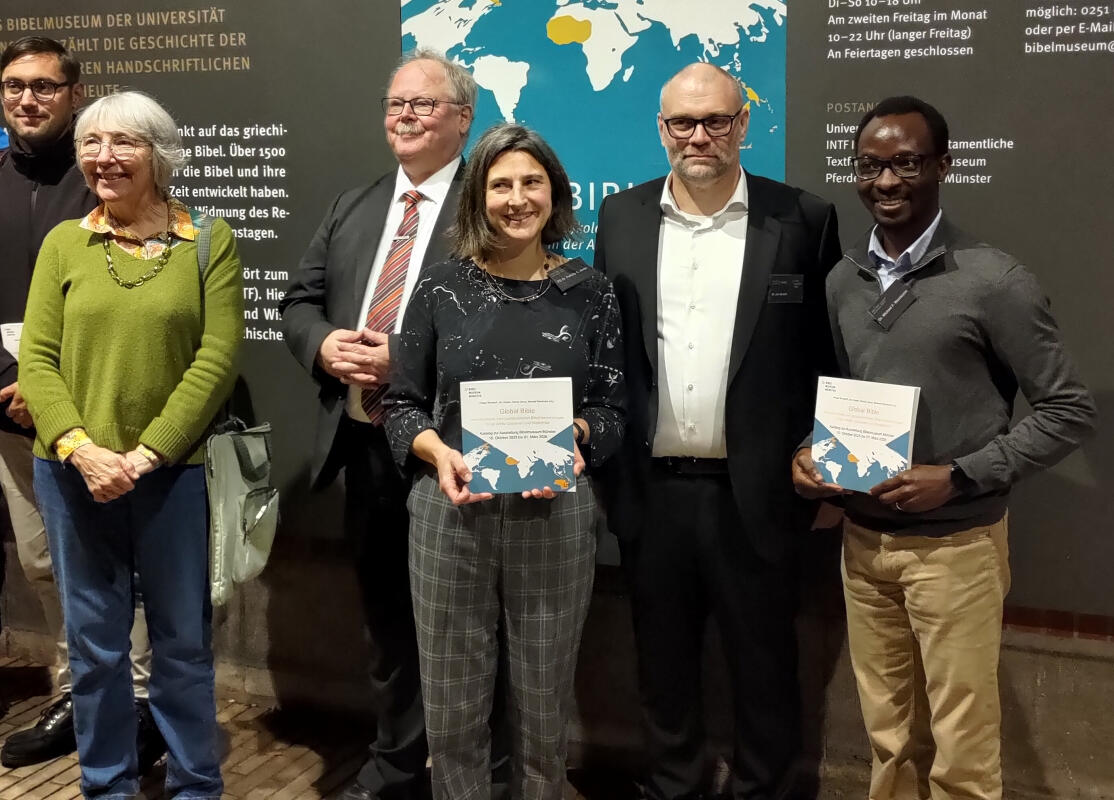
Left to right: Michael Wandusim, Felicity Jensz, Ben Weber, Christian Herrmann, Hilary Carey, Holger Strutwolf, Martha Frederiks, Floris Solleveld, Kennedy Kwame Owiredu, Friedrich Tometten.
The workshop included three panels, beinning with a series of presentations by representatives from international Bible societies active in the three case study regions of the Global Bible project. Dr Kennedy Kwame Owiredu of the Ghana Bible Society discussed the current work of the society in multiple media and the many languages of Ghana. These include recent work to make video recordngs of Bible translation in Ghanaian sign language. This is particularly important becuase of the low literacy rates among deaf Ghanaians. This was followed by an account by Friedrich Tometten, Bible consultant for the Indonesian Bible Society, of his fieldwork translating into Yali (Yaly, Jalè, Jaly) a Papuan language of Indonesian New Guinea. Tometten argued that language was a powerful instrument for identity in the face of intense colonial pressure, in this case Indonesian. He illustrated the complex layers of meaning possible in Yali and the unique world view it was able to represent. This session was followed by a presentation by Leeza Awajobi including a video of her poetic response to missionary Christianity and the loss of her mother tongue. After lunch, there were three presentations, by Floris Solleveld on Bible societies and comparative linguistics, by Hilary Carey on the Bible in the Arctic, and Marha Fredericks on translating the Bible on the Gold Coast and the politics of using ajami (Arabic) script to print Christian scripture. In the final session, Dr Christian Hermann provided an overview of the recent exhibition at the State Library of Württemberg (Württembergische Landesbibliothek or WLB), which currently has one of the world’s largest Bible collections and has recently held an exhibition on the colonial impact and reception of the Bible. The lead researcher for the exhibition, Michael Wandusim, provided an overview of the methodology and rationale behind the choice of exhibits for inclusion in the exhbition, noting that the intention was to illuminate the lengthy process involved in a Bible translation as well as the particular role of mother tongue and Indigenous co-translators in the process.
Exhibition
The workshop was followed by a reception and talk to launch the exhibition and the newly published catalogue, displayed in the image below. The launch was well attended by people of all ages who relished the opportunity to examine exhibits from across the world, and close to home, in the highly curated and professional context provided by the Bible museum.
Prof. Hilary Carey (Bristol), Prof. Holger Strutwolf (Director of the Bible Museum), Dr. Felicity Jensz (GloBil), Dr. Jan Graefe (Curator of the Bible Museum) and Dr. Michael Wandusim (GloBil), from left to right
The Global Bible exhibition runs until 1 March 2026, with a public guided tour taking place every Sunday at 3 p.m. The exhibition is the culmination of three years of research and collaboration with researchers, Bible societies, artists and museum professionals looking at the colonial and post-colonial legacies of Bible translation.
In his presentation to the opening session, Prof. Holger Strutwolf (Direktor Bibelmuseum) described the origins of Bible translation and the complex histories of landmark works, such as Erasmus’s Greek New Testament (1516), generally referred to as the first published edition in the original Greek language.
Felicity Jensz introduced the first of the three case study regions of the Global Bible project, namely that for the Arctic. In this section, ethnographic artefacts sourced from the Moravian archives have been placed together with the first translations into Greenlandic (Kalaallisut) which were originally completed under royal patronage in the 18th century.
Michael Wandusim then discussed the exhibits relating to Ghana in West Africa, noting that Bibles were only the last stage of a complex translation process, that also involved the creation of word lists, orthography, grammars, and translations of short sentences, passages and scripture books, before culiminating – if ever – in a complete translation of all books of the Bible.
The third case study region is that of Oceania and Australia, vast regions in which there were multiple incursions by different imperial and Christian missionary agencies. This is reflected in the complex transmission history of Bibles in this region. One telling example, is the Tahitian Bible of Pomare II (1774-1821), completed after his strategic alliance with the London Missionary Society. Pomare leading not just to translation of the Bible, but also a new lawcode.
Poet and storyteller, Leeza Awojobi.
Reflections on the colonial reception of Bible translations was led by spoken word artist, Leeza Awojobi, whose poem was one of two commissioned art works produced as part of the project. Three drawings by New Guinea artist Alfred Manfred Wkeng Aseng narrated the missionary journey of his brother, who donated land to the Anglican mission to come to the village and set up a church and school. Floris Solleveld explained the process which led Aseng to contribute to the project and the need for Indigenous perspectives on the colonial process.
Finally, there was a presentation of works which have been used to develop the digital map of Bible translations, including the Book of a Thousand Tongues, originally published by the American Bible Society in 1939, and re-issued with a marked turn to empower mother tongue translators under the editorship of Eugene Nida for the United Bible Society in 1972. This has formed by the basis for the Global Bible Project (GloBil) dataset, an accessible dataset available in multiple formats with a range of queries now available through FactGrid.
Catalogue
The Global Bible exhibition is accompanied by a comprehensive catalogue of over 100 exhibits and thematic essays. This is published by LIT Verlag and edited by Holger Strutwolf, Jan Graefe, Felicity Jensz and Michael Wandusim: Global Bible – Legacies of (post)colonial Bible translations in the Arctic, Oceania, and West Africa. Catalogue for the exhibition at the Bibelmuseum Münster from 10 October 2025 to 1 March 2026. Copies may be obtained from the publisher.
This week I paid my first visit to the National Art Library, which is housed in the Victoria Albert Museum in London. The splendid library is open three days a week, and I wanted to look for recent research on bible mania in the nineteenth century, and evidence of the response to the output of the British and Foreign Bible Society.
The Victoria and Albert Museum is a treasure house of art and technology and represents many of the Victorian values also reflected in the overseas missionary movement and its associated Bible societies. It is the confidence and assumption of superiority that seems so anachronistic today, and the assumption of right to power and civilization. With friends, I wandered through the new galleries to Asian, Chinese, Korean and Japanese art, then made my way through the ‘cast galleries’ of what were believed to be the great western works from Christian Europe. The National Art Library is on the second floor, and they are exceptionally welcoming to visitors. After signing up online and providing an address, visitors were welcome to use the library.
It was a pleasure to access printed collections of valuable and large-format volumes, all placed in accessible galleries. Every desk enjoys the luxury of a book stand for managing the large volumes which line the shelves.
Although I have read it online many times, I was able to re-visit the article on Bible Societies in the 11th edition of the Encylopedia Britannica (EB), the version published by Cambridge University Press in 29 volumes from 1910 to 1911. Although Edward VII (r. 1901 – 1910) scarcely lived to enjoy it, this edition exudes the values and confidence of the Edwardian age, the maximalist point of the expansion of the British Empire. The entry on the Bible (vol. 3, pp. 849-894), left no doubt as to the stature of this work in the views of the EB editors; it was followed by another leisurely account of the English Bible (pp. 894-905), which points out that the controversy and labour involved in what remains the only authorised revision of the King James version. The revision to the New Testament (published in 1881) was completed in 407 meetings over more than ten years; that of the Old testament (published in 1885) took 792 days, with the Aprocrypha finally published in 1894. This casts a valuable light on the challenge of translating the Bible into other global languages, and an appreciation of the intellectual, linguistic, social and political negotiations that drove their production.
The article on ‘Bible Societies’ was written by the Rev. Thomas Herbert Darlow, the co-editor with H. F. Moule of the monumental account of the Bibles held by the BFBS, the Historical catalogue of the printed editions of Holy Scripture in the Library of the British and Foreign Bible Society (1903 -11). This mighty catalogue deserves an entry of its own, but it is testament to Moule and Darlow’s scholarship and rigour that it remains in use, while regularly updated, to this day. In his EB entry, Darlow gives considerable prominence to the BFBS, but does not entirely neglect predecessors, including the Canstein Society, the SPCK, the The Protestant Bible Society of Paris (Société Biblique Protestante de Paris) and even the Roman Catholic Propaganda.
One purpose of my visit was to advance work for my presentation later in the month on ‘The Future of Research in Bible Society Collections‘. This is organised by Joshua Fitzgerald, Eyal Poleg, Lucy Sixsmith and Harry Spillane at the University of Cambridge. I will be presenting on our efforts to identify mother tongue translators in the archive. This is always a challenge given the Bible Society’s firm policy of publishing ‘without note or comment’, but there are vestiges of the work of native speakers in the correspondence and letter books of the Society. Let us see how many we can uncover.
Last week, international delegates from around the world met for the Translating Colonialism conference at Westminster College, University of Cambridge.
The conference was the major event for the second year of the Global Bible project, and has been over a year in the planning and thinking.
Congratulations and thank you to everyone who joined us for this event!
Delegates to the Translating Colonialism Conference, Westminster College Cambridge, 7-8 November 2024.
Papers were organised into panels which corresponded roughly to geographical and chronological themes, though the range and diversity of topics and approaches was a key feature of the conference.
The conference began with a short presentation by the Global Bible team, both the Münster strand led by Felicity Jensz and Michael Wandusim (who was unfortunately not able to attend) and the Bristol strand, with Hilary Carey, Floris Solleveld, and Mei Mei Cheung. This outlined the origins of the project and its focus on three case study regions in colonial West Africa, Oceania, and the Arctic, but with the conference extending that to include participants presenting on bible translation in China, Russia, India and across a wider time frame, from the early Christian era to the modern day.
For the first panel, Daniel Jeyaraj (Liverpool Hope) and Hepzibah Israel (Edinburgh) took us to Tamil Nadu. Jeyaraj discussed the Danish Lutheran missionaries who undertook the first translations into Tamil in the Danish colony of Tranquebar. Israel analysed the translated bible for its materiality and as an icon for the translation process, with a series of striking illustrations including Bible colporteurs and Bible women in colonial India.
Delegates reviewing the drawings by Manfred Wkeng Aseng at the Translating Colonialism conference.
The second panel included a number of technological challenges and included a presentation from Benjamin Weber on behalf of the Münster digital humanities team on the missionary map. The missionary map is one of the outputs from the Global Bible project, building on an initial template from the Book of a Thousand Tongues, edited by Eric North (1938) and later by Eugene Nida (1972), with permission from the United Bible Society. There was a lively discussion of aspects of the map as a tool for future researchers, with valuable contributions made by Neil Rees (United Bible Society).
Two artistic commissions followed this presentation. Leeza Awojobi, a Bristol-based poet and storyteller, provided a poem and video reflection on the heritage of her family, originally from the former German colony of Cameroon and her ‘lost’ mother tongue of Kpwe (Mokpwe). This was followed by the work of the New Guinea artist Manfred Wkeng Aseng, and the coming of Anglican missions to his home place of Kaironk in the highlands, depicted using traditional images.
Manfred Wkeng Aseng, drawing of his brother’s travels from Kaironk in the PNG highlands (bottom right corner) to Simbai, Madang, Popendetta and St Paul’s and St Peter’s cathedral in Dogura (top right corner).
Onesimus Ngundu, for Cambridge University Library, presented on the library and archives of the British and Foreign Bible Society. This was followed by presentations on aspects of translation from two different times and perspectives: Tyler Horton (Cambridge) on strategies for translating the Hebrew term ruah (רוּחַ) ( ‘wind’ ‘breath’ ‘spirit’) in the Septuagint, and Uchenna Oyali (Abuja) on the changing meaning of nsọ (‘holiness’/ sacred/ unclean), a word with both positive and negative connotations, in Igbo bible translation.
For the final session of the day, Brian Stanley (Edinburgh) analysed the meaning of the term ‘heathen’ and questioned whether the derogatory connotations of this term had any real world impact on the social demarcation of race in colonial societies. Laura Rademaker (ANU, Canberra) took us to post-colonial era in supposedly decolonised Australia. Through her analysis of the bilingual school policy in the Northern Territory she noted the long tail of missionary education, which persisted long after the formal work of missions in settler countries had passed. Mia Jacobs (Bristol) analysed the meaning of biblical references to menstruation in Leviticus and the woman with the twelve-year flow (Matthew 9:20-22; Mark 5:25-34; Luke 8:43-48) to question pejorative interpretations of the status of menstruation in both the ancient world and today.
We enjoyed an excellent conference dinner at Galleria in Cambridge – readying us for another day of talks.
De Valera Botchway (Cape Coast) led the morning discussion with a challenge to understand the full meaning of traditional religious terms, as they were translated into new biblical contexts. His example was the Tiwi (Akan) term nyamesom pa which he argued was mistranslated to mean ‘religion’ as a practice set apart from other parts of life. He argued that traditionally there was no such distinction, and that translation into a western idiom undercut older life- and knowledge-ways. John Ekem (Accra) examined the earliest mother tongue translaters of the bible on the Gold Coast through the work of Christian Protten and Jacobus Capitein. He argued that they were more than translaters but necessarily acted as cultural mediators providing dynamic interpretations of language to meet the new needs of the times. Toon van Hal (Leuven), analysing the compilation of translations of the Lord’s Prayer, explained that this practice reflected in miniature the global bible project, and provided insights into the developing understanding of global languages, and the relationship between scholarly and mission-driven linguistics.
For the sixth panel, Holger Strutwolf (Münster) returned us to the earliest centuries of Christianity, pointing out through a rich selection of examples, that issues of translation and the editing of scripture are not new but are inherent in the transmission of scripture into new languages. In two complementary papers, Lisa Kerl (Münster) examined the role of German-speaking missionaries and the challenge of translating the bible into classical Chinese in the late 19th and early 20th centuries; Anastasia Akulich (Leeds) considered the work of Russian Orthodox missionaries and their close engagement with Chinese Orthodox Christians and the extent to which the latter were effectively independent agents in the work of translation.
James Wyld. The World: designed to show the languages and dialects into which the BFBS has translated the scriptures. 2nd ed, 1841
The final session brought together papers from the two global bible project teams. Floris Solleveld outlined how the global translation project of the BFBS and affiliated societies resulted in a virtual as well as a physical world map of languages, as well as in massive repositories of linguistic data. Felicity Jensz examined the connections between German and British Bible Societies in colonial West Africa, highlighting the significant achievement and contribution of mother tongue translators to the present day. Finally, Judith Becker provided a summing up and review of the proceedings across two days of intense discussion.
The final activity for delegates was to take the short walk to Cambridge University Library to visit a display of items from the British and Foreign Bible Society. Selected by Floris Solleveld, these highlighted the work of Indigenous and mother tongue translators from many cultures, as well as archival and printed objects showing the history and progress of individual bible translation projects, as well as the 1841 copy of Wyld’s Map of the world, with all the languages into which the BFBS had translated the bible.
The nineteenth century has been called the century of bible societies (Risch quoted by Gundert, p. 34). In German-speaking lands alone, some 500 bible societies were established in the nineteenth century. In contrast, in the eighteenth century, there was only one bible society established in German lands, the Canstein Bible Society (Cansteinsche Bibelanstalt) (Heidenreich 2024). What then led to the proliferation of bible societies in the nineteenth century?
Figure 1: Establishment of German Bible Societies in nineteenth century (number per year). Data from Gundert 1987.
One major external influence in the establishment of German bible societies came from the British and Foreign Bible Society (BFBS), established in London in 1804. At the establishment of the BFBS a circular was sent out to influential Christians, both theologians and laypeople, in Europe to inform them of the new society, and to encourage them to establish their own bible societies. The BFBS also supplied funds to encourage and support the establishment of bible societies. Thus, already in 1804 the German Bible Society was established through a cooperation of two Bible Societies in German-speaking Basel (Switzerland) and Nuremberg (Franconia). Both of these locations were in the south, meaning that they were not in direct competition with the Canstein Bible Society in the north. Initially, the main seat of the German Bible Society was Nuremberg, however, that changed soon after as the printing was transferred to Basel. In the aftermath of the French invasion of Switzerland, the Basel Bible Society catered to a Swiss audience by publishing French-language bibles for Protestants, who had been affected by the violence. The focus on internal Swiss needs meant that the German-language need for bibles was not adequately covered to the disappointment of many. This desire for bibles was in part a reflection of the pietist movement of the early eighteenth century that placed a focus on bible reading as well as the activities of lay people within religious communities. Moreover, the general desire for education inspired a Christian feeling of responsibility towards the poor and the growth of German religious societies. Thus, when the BFBS was established in 1804 the internal influences on religious people in German lands were such that the BFBS model was easy to replicate. However, before a reorganisation of the German Bible Society could be occur, continental Europe was at war.
1812-1830
With the Napoleonic Wars and the Continental Blockade (Blocus continental) from the end of 1806 to April 1814, communications between England and the continent mostly ceased. In those years, only a few bible societies were established. In 1812, Carl Friedrich Adolf Steinkopf (1773-1849), who was a German theologian and former secretary of the Christian Society (Deutsche Christentumsgesellschaft) in Basel, was able to travel back to continental Europe via Sweden. He was pastor of the Lutheran Church of the Savoy, London, which was the second oldest German-speaking church in Great Britain, being founded in 1694.Steinkopf was also a member of the BFBS as well as other religious societies. On the continent, he visited many of his former contacts in religious circles and persuaded many to establish bible societies, with the financial support of the BFBS and following the model of the BFBS system.
When Napoleon was defeated and the blockage was raised, four men from the BFBS travelled to continental Europe to help establish Bible societies. John Patterson, Robert Pinkerton, Dr. Christian Schwabe (minister of the German Lutheran Church, Goodman’s Fields, London) and Ebenezer Henderson were very effective, with 25 bible societies established in the German states in 1814 alone. The method was to provide funds for the establishment of a bible society firstly in the large cities, then subsequently focusing on the smaller cities. The bible societies were to be ecumenical—some even included Catholics—and were encouraged to be independent societies, rather than assuming subsidiary positions with the BFBS network. Nevertheless, the BFBS was seen by many German bible societies in the early nineteenth centruy as the ‘mother’ society.
There was a perceived need for affordable bibles in the German Confederation, as years of war and blockade had left people without access to the Bible. Added to this was an increased interest in reading the Bible, which had been encouraged by the establishment of a number of religious societies in the early nineteenth century. Despite such interest, the supply of Bibles was quite restricted. The seven larger Bible societies (Canstein, Prussian, Württemberg, Saxon, Bavarian, Schleswig-Holstein and Strassburg) usually printed or had printed their own bibles, while the smaller societies obtained their bibles from these seven or other printers. Initially, bible societies gave away up to a third of all bibles free of charge, as in the case of the Württemberg Bible Society, but by the end of the century this figure had fallen considerably, so that the vast majority of Bibles were purchased (Gundert 1987, p. 172).
In the seven years between 1814-1820, 185 new bible societies were established in the German Confederation. The majority of these bible societies saw themselves as stemming from the BFBS. Unlike the BFBS, however, the German bible societies did not initially see their role as sponsors of foreign language translations of the bible, rather as publishes of languages of the people in their own jurisdictions. This included not only Standard High German (Hochdeutsch), but languages such Polish and Sorbian. The connections to the BFBS were strained and in many cases completely ruptured when in August 1822 the BFBS declared that they would not support the publication of any bibles which included the Apocrypha, that is, the non-canonical writings placed by Luther between the Old and New Testament. Almost all of the German, Swiss, Scandinavian and French bible societies were not prepared to follow this directive and continued to print bibles with the Apocrypha, although without financial support from the BFBS. A few German societies, including those connected to the Moravian Church, agreed to the new conditions. In 1827, the BFBS committee allowed for the New Testament, or the New Testament with Psalms, to be distributed to the bible societies for free, and many German societies took advantage of these publications. However, the majority of German bible societies wished to continue circulating bibles with the Apocrypha and thus relationships with the BFBS were tempered. This resulted in the BFBS establishing around 1830 their own branch and storehouse in Frankfurt from where continental Europe could be supplied with bibles. Such developments ensured that the German bible societies became independent of the BFBS.
The time of more independence
In the period between 1830 and 1848, the year of the March Revolution, over 100 further German bible societies were established. The remit of the German bible societies was predominantly the inner mission, and at times German emigrants in places such North America. The first half of the nineteenth century was also a period in which German foreign Christian missions were beginning to be established. The Danish-Halle-English mission in Tranquebar (Tharangambadi, Tamil Nadu, India) had already been established in the early eighteenth century, followed by Moravian missions from the 1730s. The early nineteenth century would see further German Protestant mission societies be established, such as the Basel mission in 1815, the Goßner mission in 1831 or the Rhenish mission from 1828. A consequence of the increased number of mission societies was that bible societies lost some of their donors, as the former were seen to confront more pressing issues in the conversion of non-Christians than were the Bible societies in their wish to spread Christianity amongst the poor. Mission societies were strongly connected with the translation of the bible into local languages. Yet when it came to the “reduction” of oral languages to written form, German missionaries and missionary societies often relied on funds from the BFBS for the publication of bibles in indigenous languages as German bible societies did not see this as their main task. By the end of the century, when Germany had its own colonies, the fact that German bible societies rarely published foreign language bibles was seen by some religious commentators of the period to be an indication of a lack of German patriotism (Richter 1899, p. 11). A few mother-tongue bibles had been published, for example the Basel Bible Society (Basler Bibelgesellschaft) funded the publishing of the Basel Talu New Testament (China-Tibet) as well as the Ga Bible, and the Württemburg Bible Society (Württemburgische Bibelgesellschaft) supported the publishing of the Duala New Testamen, with the Bremen Bible Society supporting the publication of the Ewe Bible. But there was a belief from some people that German bible societies should do more for German missions, and thus for German colonialism. However, given that from the mid-nineteenth century German mission societies received significantly more public funding than German bible societies, there was also the pressing issue of prioritising bible versions given the limited availability of funding.
Women’s work
Missing from the current blog are female voices. Much of the material used for this blog is taken from the work of Wilhelm Gundert, who wrote the history of the German bible societies in the nineteenth century. Gundert’s work is one of a grand narrative and named men with there being little information on women’s work, or the contributions of non-Europeans to the translation, printing and dissemination of bibles. Partly Gundert explains these omissions due to lack of sources. There were, he states, a number of lady’s bible associations in Germany in the nineteenth century, however, there is scarcely any archival material pertaining to them (Gundert 1987, p. 233). This is in contrast, for example, to the work of British women. According to contemporary reports, there were more than 100 women selling Bibles in London in the early 1860s (Auxiliary Bible Society of New South Wales 1861, p. 5). British scholarship has examined the role of women noting their importance for work of the BFBS (Martin 2004; Lane 2004). Compared to their British counterparts, German women were slower to obtain the franchise, or to be able to earn their own living. Their contributions to public life are also not as often reported on as in Britain. Furthermore, women’s societies and associations often had numerous functions, for example the Female Association for the Poor and Invalids (Weiblichen Verein für Armen- und Krankenpflege) in Hamburg also disseminated bibles, without the word mentioned in their title (Gundert 1987, p. 235). Unlike mission societies, where females working in foreign countries reported on their work to European audiences, thus gaining female supporters (Habermas 2017, p. 507), there were no female role models in the German bible societies. Just because nineteenth century printed sources scarcely mention female actors, this does not mean that they were not working behind the scenes to support bible societies through donations, or through selling bibles. Yet their voices are harder to find in the dominant narratives of the history of bible societies, and thus provide a strong motivation to increase focus on them in our further research.
Sources:
Auxiliary Bible Society of New South Wales, 1861. Empire (Sydney), Tuesday 12 February, p. 5
Gundert, Wilhelm. 1987. Geschichte der deutschen Bibelgesellschaften im 19. Jahrhundert. Bielefeld: Luther-Verlag.
Gundert, Wilhelm. 1987. Festschrift zur Gründung der Privilegierten Württembergischen Bibelanstalt vor 175 Jahren. Stuttgart: Deutsche Bibelgesellschaft
Habermas, Rebekka. 2017. “Colonies in the Countryside: Doing Mission in Imperial Germany.” Journal of Social History 50, no. 3 (2017): 502–17. http://www.jstor.org/stable/45133237.
Heidenreich, Sven. 2024. “The Cansteinsche Bibelanstalt: The oldest German Bible Society.” In Global Bible: British and German Bible Societies Translating Colonialism, 1800-1914, Blog post. https://globalbible.blogs.bristol.ac.uk/2024/04/19/the-cansteinsche-bibelanstalt-the-oldest-german-bible-society/ (Accessed 11 June 2024)Lane, Sarah. 2004 “Forgotten Labours: Women’s Bible Work and the BFBS.” In Stephen Batalden, Kathleen Cann and John Dean (eds). Sowing the Seed. The Cultural Impact of the British and Foreign Bible Society, 1804-2004 (Phoenix Press: Sheffield), 53-62.
Martin, Roger. 2004. “Women and the Bible Society”, In Stephen Batalden, Kathleen Cann and John Dean (eds). Sowing the Seed. The Cultural Impact of the British and Foreign Bible Society, 1804-2004 (Phoenix Press: Sheffield), 38-52
Richter, Paul. 1899. “Was haben die Bibelgesellschaften für die Mission geleistet?.” Allgemeine Missions-Zeitschrift 26: 11-31.
Linguistic fieldwork in the Indonesian archipelago, throughout the 19th century, was largely the province of the Dutch Bible Society (NBG). Two Bible translators stand out for their contributions to linguistic scholarship: J.F.C. Gericke on Javanese in the late 1820s-1850s, and Herman Neubronner van der Tuuk on Toba Batak, Malay, Lampung, Balinese, and various other languages in the second half of the century. Their methods were as similar as their personalities were different. Gericke was pious, deferential, a bit naïve, and well liked by the colonial and Javanese elites; Van der Tuuk was an inveterate polemicist and open atheist who went half native, and whose eccentricities and vituperative letters earned him something of a legendary status.
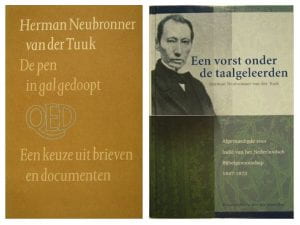
Both figure prominently in J.L. Swellengrebel’s history of the NBG in Indonesia, In Leijdeckers Voetspoor (2 vols., 1974-78); but while little has been written about Gericke since, Van der Tuuk’s correspondence as preserved in the NBG archives has been edited not once but twice. The titles of both collections are telling: Rob Nieuwenhuis’ pocket volume of letters selected for their historical or literary merit is called De Pen in Gal Gedoopt (the pen dipped in bile, 1962/82), while Kees Groeneboer’s near-exhaustive annotated edition bears the title Een Vorst onder de Taalgeleerden (a king among linguists, 2002). Annoyingly enough, the sole passages that Groeneboer sometimes intentionally omits are about linguistic details.
The two editions of Van der Tuuk’s correspondence, 1962/82 and 2002
What both Gericke and Van der Tuuk (as well as other NBG translators) did was set up a philological cottage industry with up to half a dozen local staff. Together with their writers and language teachers (guru bahasa), they collected and edited Indonesian manuscripts, compiled a grammar and a dictionary of the target language before setting to translation work. In Gericke’s case, the preparatory work also included setting up a short-lived Javanese language institute at Surakarta (1832-42) modelled on Fort William College; Van der Tuuk devoted part of his energies to the revision of the main Dutch-Malay dictionary. On their deaths they left two of the richest collections of Indonesian manuscripts, now in Leiden University Library. But is particularly through their periodical, lengthy letters to the NBG that their work can be followed. In effect, these are among the most detailed (and in Gericke’s case, the first) linguistic fieldwork reports from the 19th century.
A Patchwork of Languages (and Religions)
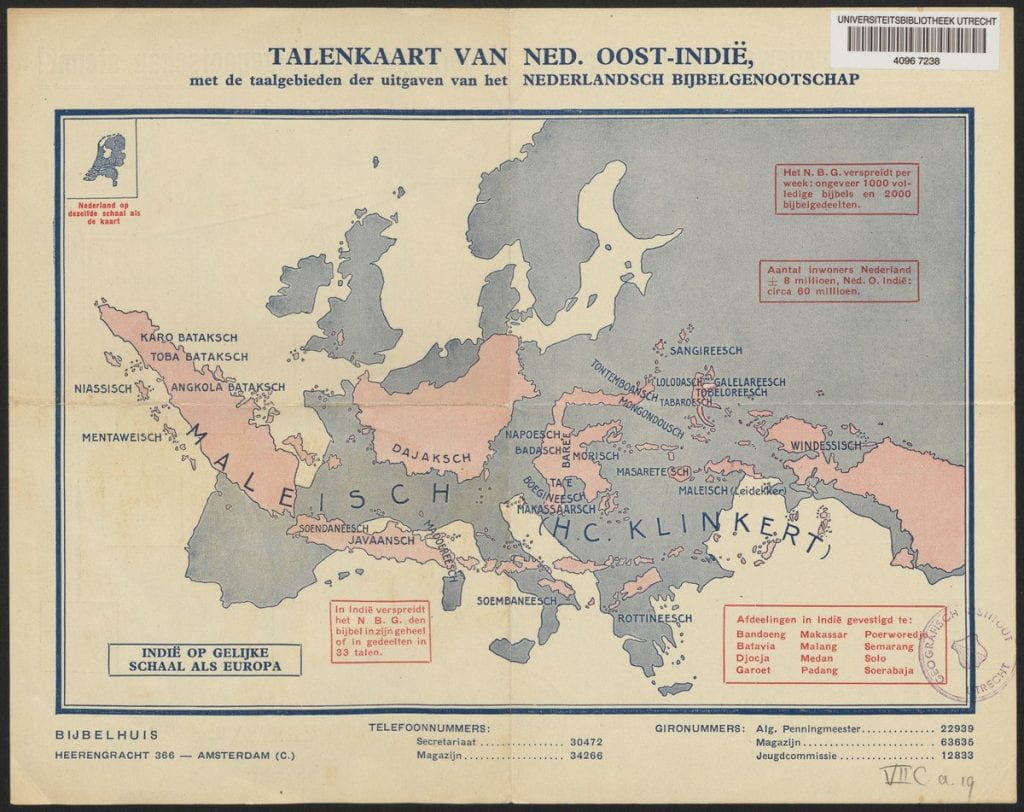
The colonial language dynamics within which the NBG operated was quite complicated. Colonial Indonesia (or the ‘Dutch East Indies’) was a patchwork of hundreds of languages, of which a dozen had their own writing systems. Malay was the lingua franca of the archipelago, of which the high literary register, written in adapted Arabic Javi script, differed quite strongly from the trade language and local varieties. Javanese was the largest language in terms of native speakers, with a literary tradition going back to the 9th or 10th century CE; at the core of that tradition was a corpus in Old Javanese (Kawi, ‘poet’, from Sanskrit kāvya) largely derived from Hindu epics and enacted at wayang shadow puppet plays. The Kawi corpus and language, however, had been preserved better on Bali, which had remained (and still is) largely Hindu while most of Java had converted to Islam. Batak, on which Van der Tuuk worked, was a language cluster on Central Sumatra of which most speakers adhered to Indigenous religious traditions. These were only some of the larger languages within the sphere of Dutch colonial and missionary activities; by 1936, the NBG proclaimed to have translated the Bible into 33 languages.
Language map of Indonesia showing the language area of NBG translations, 1936
That linguistic patchwork also clearly reflected religious rivalries and religious syncretism. All the Indonesian writing systems, like those of Southern India, derived from Brahmi, and had developed together with the spread of Hinduism and Buddhism. Malay, on the other hand, was strongly linked to the spread of Islam, still ongoing in the 19th century, and the preponderance of Malay is the main reason why Dutch, though officially the language of colonial administration, did not become a ‘world language’ like French or Spanish. But Indonesian and especially Javanese Islam was thoroughly syncretic, with Sufi, Hindu, and Buddhist elements. When Gericke arrived in Surakarta to translate the Bible into Javanese, the Java War (1825-30) was still raging, in which Dutch colonial rule was challenged by the charismatic prince Diponegoro, who styled himself as both a traditional wayang hero and a sufi seer. In an early letter, Gericke recounts a visit to a “Javanese Seminary [pesantrèn ≈ madrassa] for the formation of priests” from which a lot of Diponegoro’s following had been recruited (as well as, presumably, Gericke’s own language teachers):
The number of students before the war was nearly 3000; now there are barely 200. The Emperor of Surakarta has bequeathed 31 dessas (villages) to it for its maintenance. Teaching consists mainly of learning to read the Qu’ran and memorizing the five daily prayers. Moreover students are educated in the secrets of the Buddhists and Betoros [Hindu deities], which have been preserved by the priests either through tradition or in their books after the conversion of the Javanese to Islam.
The letter is telling in a number of ways, not only about religious syncretism and religious politics but also about Gericke’s own attitudes. Though loyal to the Dutch authorities – he argued that “nothing can be achieved without them” – he became increasingly critical of their offhand treatment of the Javanese, and gained a lot of prestige by getting the head of the pesantrèn out of prison. After that, he visited the ruins of the Buddhist temple complex Borobudur, speculated about Buddhism as a purely philosophical religion, and dreamed of a journey to Bali to learn proper Kawi. He stands in stark contrast to his predecessor/rival as a translator, the Baptist missionary Gottlob Brückner, whose entire edition of the New Testament in Javanese, printed at Serampore, was seized by the Dutch authorities because he was also distributing anti-Islamic tracts right after the end of the Java War.
Van der Tuuk’s attitudes were a lot more antagonistic than Gericke’s. He regarded Bible translation as a hopeless task because each language was so deeply ingrained with a specific – religious – worldview that any translation would go either against the spirit of the language or of Christianity. Yet while he loathed the task, the one positive role he saw for Christianity was as an antidote to Islam, which he loathed even more and which was rapidly making inroads in the Batak lands. (Nowadays, Batak religiosity is roughly 55% Christian / 45% Islam.) Nor did he have many kind words to spare for Chinese traders, Javanese servants, Lampung peasants, the local nobility, Dutch missionaries, or the Gouvernement. Ironically, after an early incident in which he tendered his leave in a heavy fit of tropical fever, his relations with the NBG remained quite good throughout, although they knew full well that he was not a ‘theologizer’: they tolerated his eccentricities and heterodoxies because of his unmistakable merits as a linguist. When he finally left the NBG for a much-better paid position in the civil service in 1873, his last letter to them a month later already expressed regrets because his new employers were much more narrow-minded and less respectful of his intellectual independence.
Van der Tuuk’s cottage industry was also decidedly more messy. While Gericke mainly interacted with Javanese clergy and nobility and worked in the proximity of the court of Surakarta, Van der Tuuk decided quickly that Batak as spoken in the district capital was too ‘contaminated’ with Malay and settled in another harbour town, welcoming and paying anyone who could provide him with stories, manuscripts, or instruction in the various Batak dialects. One visitor recounts the scene:
He started by taking a teacher – a Guru – into his house. This man soon became his loyal companion, who ate and drank with him and accompanied him on many walks. Van der Tuuk asserted that, by talking to this Guru in all circumstances, he would soonest find out all the subtleties of the language. And it turned out he was right, for soon he felt able to have long discussions with all kinds of people from the hinterlands. He used the evenings to begin with his grammar; most often he was working until late at night. When I knocked on his door at six to go to the bustling river, he was often very sleepy still. I sometimes wondered at the sight of a half a dozen Batak strangers sound asleep in his parlour.
Van der Tuuk even floated the idea of marrying a Batak girl to learn the language more intimately – itself an indication of how, even while going half native, he still thought from a colonial perspective. He complained about the difficulty of finding good writers and servants in Barus, and two of his Batak teachers left after one of his fits of ire. If Gericke’s relationship with his teachers was much more formal, we also know more about his longtime instructor, Mas Ngabehi Ranuwito, than about any of Van der Tuuk’s associates, whom he hardly ever mentions by name.
The Resurrection of Kawi
Although there had been 17th/18th-century colonial studies of Malay (including various dictionaries and a Bible translation), systematic study of the languages of Indonesia only started with the creation of a central government during the British occupation of Java (1811-16). Kawi, as the most ancient and high-prestige language, played a central role in it: a hundred pages in Vice Governor Stamford Raffles’ History of Java (1817) are devoted to Javanese literature and a translation/synopsis/ commentary of the Brata Yudha (the 12th-century Kawi adaptation of a section of the Mahabharata), based on manuscripts plundered from the kraton (palace) of Yogyakarta and made with the aid of two Javanese nobles. Wilhelm von Humboldt’s posthumous magnum opus on Malayo-Polynesian languages, Über die Kawi-Sprache auf der Insel Java (1836-39), used this material as the footstone for a historical-comparative grammar, often approvingly citing Gericke’s Javanese primer and grammar. The same is true for the equally massive, unpublished Kawi-Javanese dictionary by his secretary, Eduard Buschmann.
This philologization – also of living languages like Malay and Javanese, in which Raffles and his deputy John Crawfurd collected hundreds of manuscripts – formed the background for Gericke’s and Van der Tuuk’s work on Javanese and Balinese, and especially their dictionaries. What they sought to do was not only to study the lexicon but also to actively purify the language by singling out the Kawi elements. Gericke, who regarded Surakarta Javanese as the uniform standard and other varieties not merely as dialects but as a deformed ‘patois’, sought to cultivate the Kawi element and increase the understanding of it; at the Javanese Institute he hosted fully staged wayang performances. Van der Tuuk, conversely, sought to promote the study and use of Balinese for its own sake, without the pedantic use of half-understood Kawi expressions:
Some Balinese, especially the learned, despise Balinese literature, saying of this or that Balinese writ anjar (it’s new), which means as much as not worth reading. This is also why one searches in vain for useful Balinese texts, because all that is written is full of Kawi words, some of which rendered opaque by excess display of learning. The commentaries to Kawi poems cannot be understood by anyone who does not practice Kawi, for the desire to look learned makes the interpreter use words which are even harder to understand than those they are meant to explain. Here Byron’s quip applies: I wish he had explained his explanation.
A complicating factor for Gericke, especially in Bible translation, was that the main division in Javanese (and in Balinese) is not between ‘elite’ and ‘common’ sociolects but between a ‘top-down’ register used towards people junior in age or rank (ngoko), and a more ornate and periphrastic ‘bottom-up’ register used to address superiors and elders (kromo). This prevades every aspect of the language, with parallel words for nearly everything. Gericke set out to translate the Bible in kromo which was more humble and dignified but changed his mind at a late stage in the translation process because ngoko was more clear and succinct and because the humble register did not convey enough authority. In passages with shifts in speaker perspective, he was dragged into a game of language pingpong:
A small start that I have made with the translations of the Psalms convinces me of the difficulties. […] For example, the second Psalm has seven changes of speaker, which the language must adapt to.
Verse 1 and 2, the Poet speaks Kromo; Verse 3, the enemies of the King upon Zion, as rebels, speak Ngoko; Verse 4 and 5, the Poet again speaks Kromo; Verse 6, God himself speaks Ngoko, differing from that of the rebels; first half of Verse 7, the Anointed speaks Kromo; the other half of the seventh to the end of the ninth verse, containing the words of the Lord to his Anointed One, are Ngoko again; in the final three verses, the Poet speaks Kromo in his admonition to the rebels.
If one sought to use one and the same language in the entire Psalm, no Javanese would understand it. The difference between Kromo and Ngoko is often as big as between Dutch and Polish.
Note that Psalms 2:8 is where God says, in one of the most colonial passages in the Bible, “Ask of Me, and I will give You / The nations for Your inheritance / And the ends of the Earth for Your possession”.
Legacies
Gericke was repatriated in 1857 in what his physician described as “a general state of debility”, and though he seemed to have recovered somewhat back in Europe, he died during a family visit in Düsseldorf towards the end of that year. His Javanese Bible translation, for all its philological merits, did not become the standard translation: it lost out eventually against a more accessible rival version made by the disgruntled missionary Pieter Jansz and published by the BFBS. Van der Tuuk’s Toba Batak Bible also did not establish a lasting standard, because the language changed too much through colonisation and evangelisation. This was as he had predicted, arguing that the Biblical register had to develop in religious practice; accordingly, his work was later revised and used as a matrix by Rhenish missionaries whom he had trained. Van der Tuuk spent his last two decades on Bali, increasingly isolated from Dutch colonial society, working on his four-volume Kawi-Balinese-Dutch dictionary that appeared posthumously. On his death the notary listed among his possessions nearly fl. 140.000 in bonds and assets, the richest manuscript collection in Indonesia, some pots and pans, two donkeys, a dozen chickens, and a hut valued at ten guilders.